

Upcoming Events
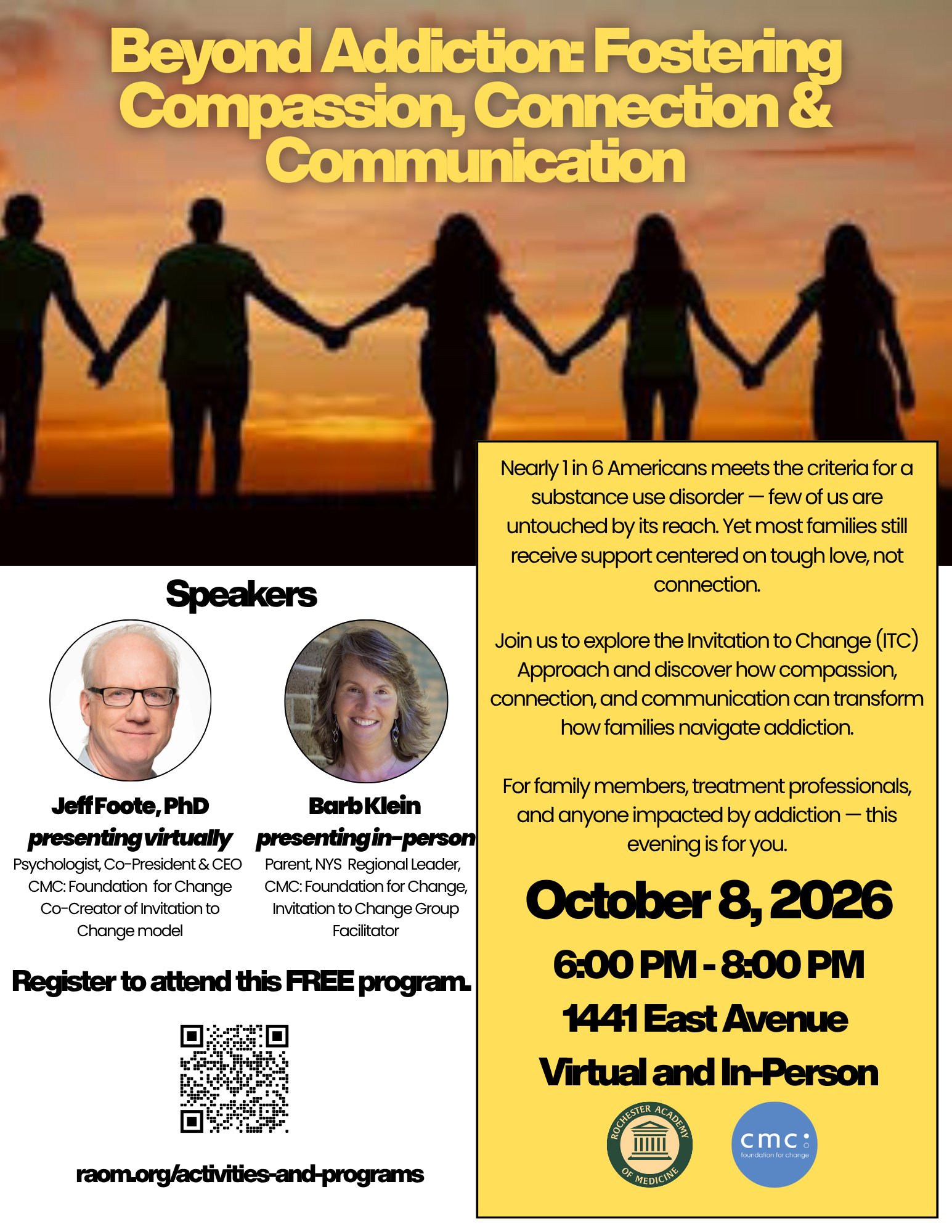
The Invitation to Change Approach: Breaking Stigma, Supporting Families, Improving Outcomes for People Struggling with Addiction

CMC:Foundation for Change is recognized by the New York State Education Department’s (NYSED) State Board for Social Work as an approved provider of continuing education for Licensed Social Workers #SW-0581. This program is approved for 1 continuing education contact hour.
CMC:Foundation for Change is recognized by the New York State Education Department's State Board for Psychology as an approved provider of continuing education for licensed psychologists PSY 0297. This program is approved for 1 continuing education contact hour.
Rochester Academy of Medicine is accredited by The Medical Society of the State of New York to provide continuing medical education for physicians.
Rochester Academy of Medicine designates this live activity for a maximum of 2 AMA PRA Category 1 Credits TM. Physicians should claim only the credit commensurate with the extent of their participation in the activity.


The Corner Society "The Early Atlantic Slave Trade and the Invention of Modern Corporeality"
Pablo Gómez
University of Wisconson-Madison
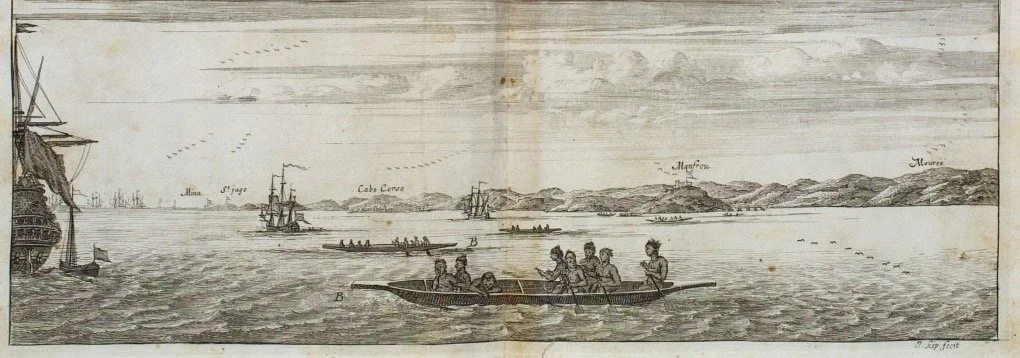
This talk examines how early Atlantic slave trading communities made human corporeality articulable with a new set of ideas about finance, facts, objectivity, and measurable risk that emerged in the early modern era. These communities drew on centuries of legal, commercial, financial, and maritime material customs and ideas. Through their violent procedures, Iberian Atlantic slave trading communities abstracted and assimilated groups of human bodies to numbers. They did so to protect their financial interests rather than caring for enslaved people. The ruthlessness inherent in these practices became ingrained in the modern corporeal mathematics that emerged from the early slave trade and diffused through its vast political, financial, logistical, and intellectual networks. The model for understanding human bodies these communities created foreshadows and shares basic notions with those sustaining the intellectual edifice of disciplines as varied as political arithmetic, economics, population health, demographics, epidemiology, and contemporary biomedicine.
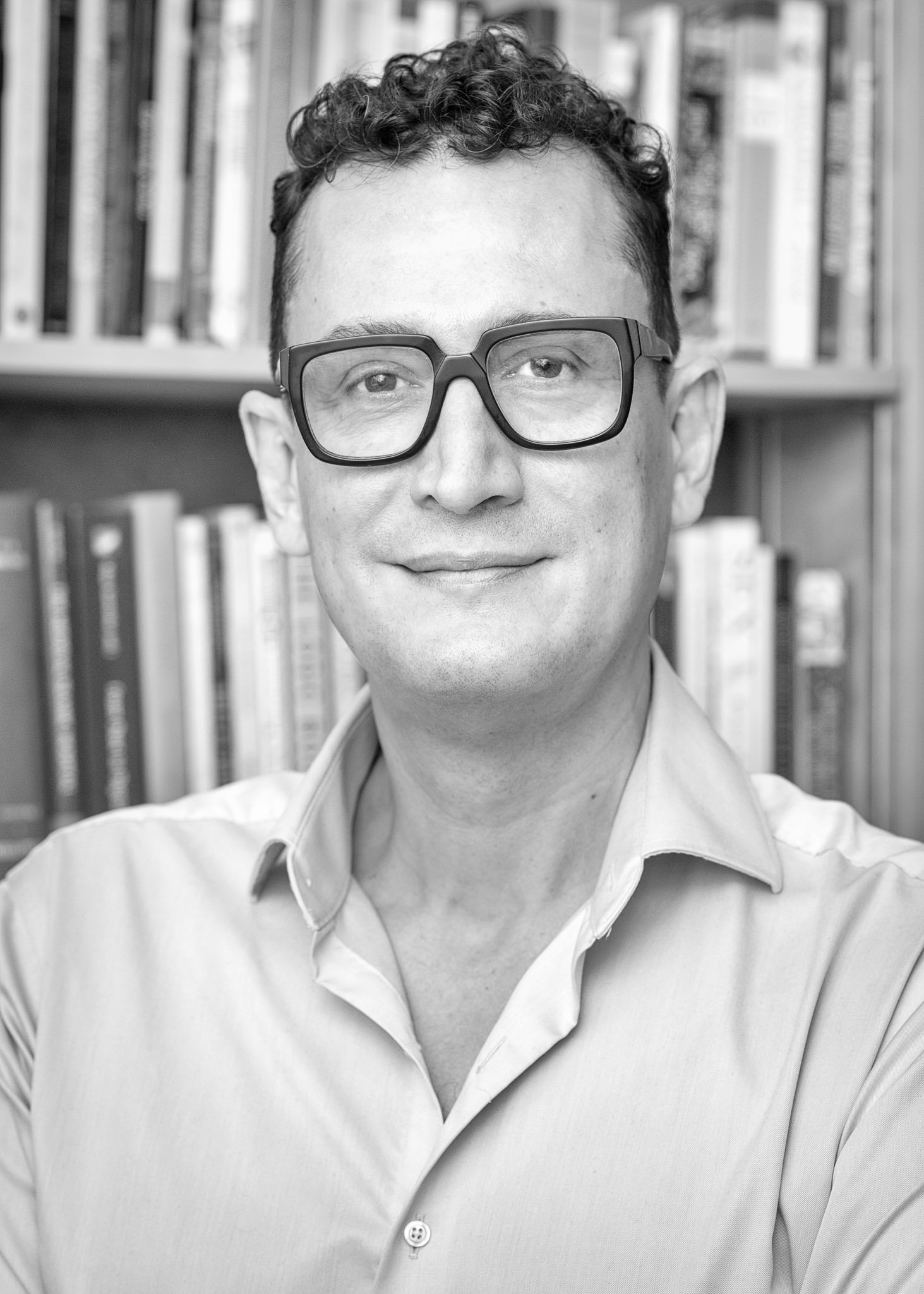
Pablo F. Gómez is Professor of Medical History and History in the Department of Medical History and Bioethics, and the Department of History at the University of Wisconsin, Madison. Gómez is interested in histories of health, the human body, material practices, and knowledge-making about the natural world in the early modern world, with a particular focus on the histories of Latin America, the Caribbean, and the African diaspora. Gómez new book, Bloody Numbers: The Early Atlantic Slave and the Invention of the Modern Corporeality, is forthcoming with the University of Chicago Press (June 2026). The book examines how, through their material practices, Iberian Atlantic slave trading communities made human corporeality articulable with a new set of ideas about finance, facts, objectivity, and measurable risk that emerged in the early modern era. He’s the author of multiple articles, chapters and two other books. His first monograph, The Experiential Caribbean, won the 2019 Welch Medal and the 2018 Albert J. Raboteau Book Prize. He also coedited The Gray Zones of Medicine, a volume that explores the history of health practices in Latin America from the 16th to the 21st century through the biographies of unlicensed healers. The recipient of grants from a variety of US and international institutions, he is currently working on a NEH sponsored project that explores the imagination of new histories of disease, value, bodies, labor, and subjectivity in the Caribbean, as well as the history of materiality in the framing of medical histories in Iberian Atlantic and Mediterranean spaces.


The Corner Society: Disability and the American Civil War
Sarah Handley-Cousins
University at Buffalo
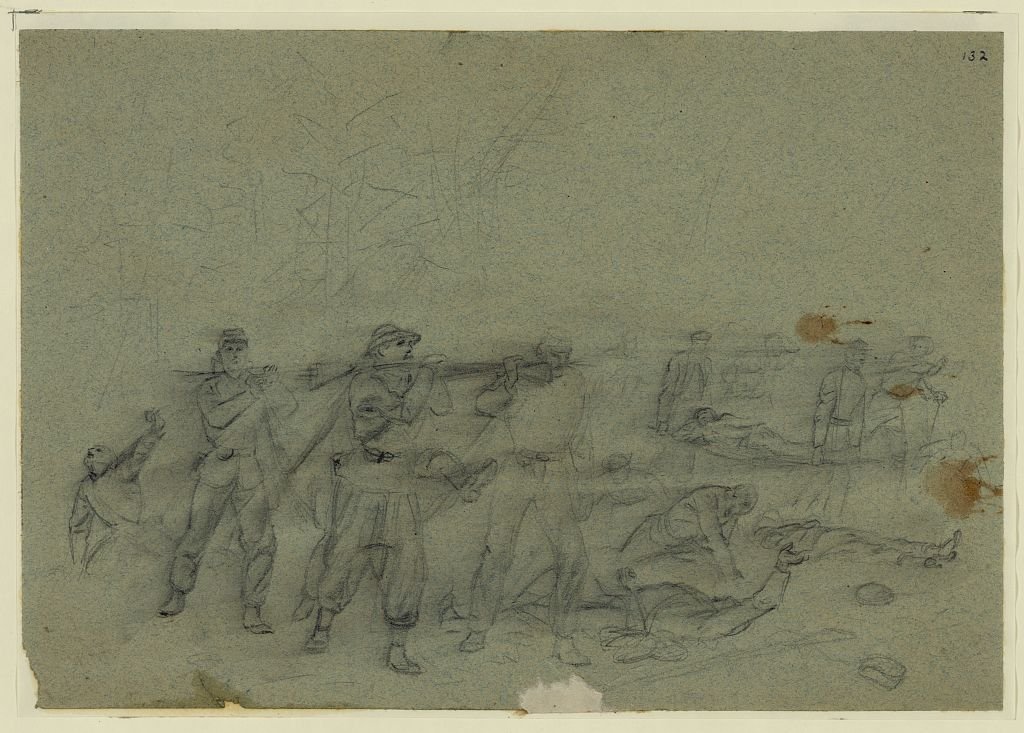
During the Civil War and long after, the bodies of Union soldiers and veterans were sites of powerful cultural beliefs about duty and sacrifice. However, the realities of living with a disability were ever at odds with the expectations of manhood. As a consequence, men who failed to perform the role of wounded warrior properly could be scrutinized for failing to live up to standards of martial masculinity. Under the gaze of surgeons, officers, bureaucrats, and civilians, disabled soldiers made difficult negotiations in their attempts to accommodate impaired bodies and please observers. Some managed this process with ease; others struggled and suffered. In this talk, historian Sarah Handley-Cousins will use a case study of Joshua Lawrence Chamberlain to explore these tensions and move us closer to a full understanding of disability in the Civil War era.
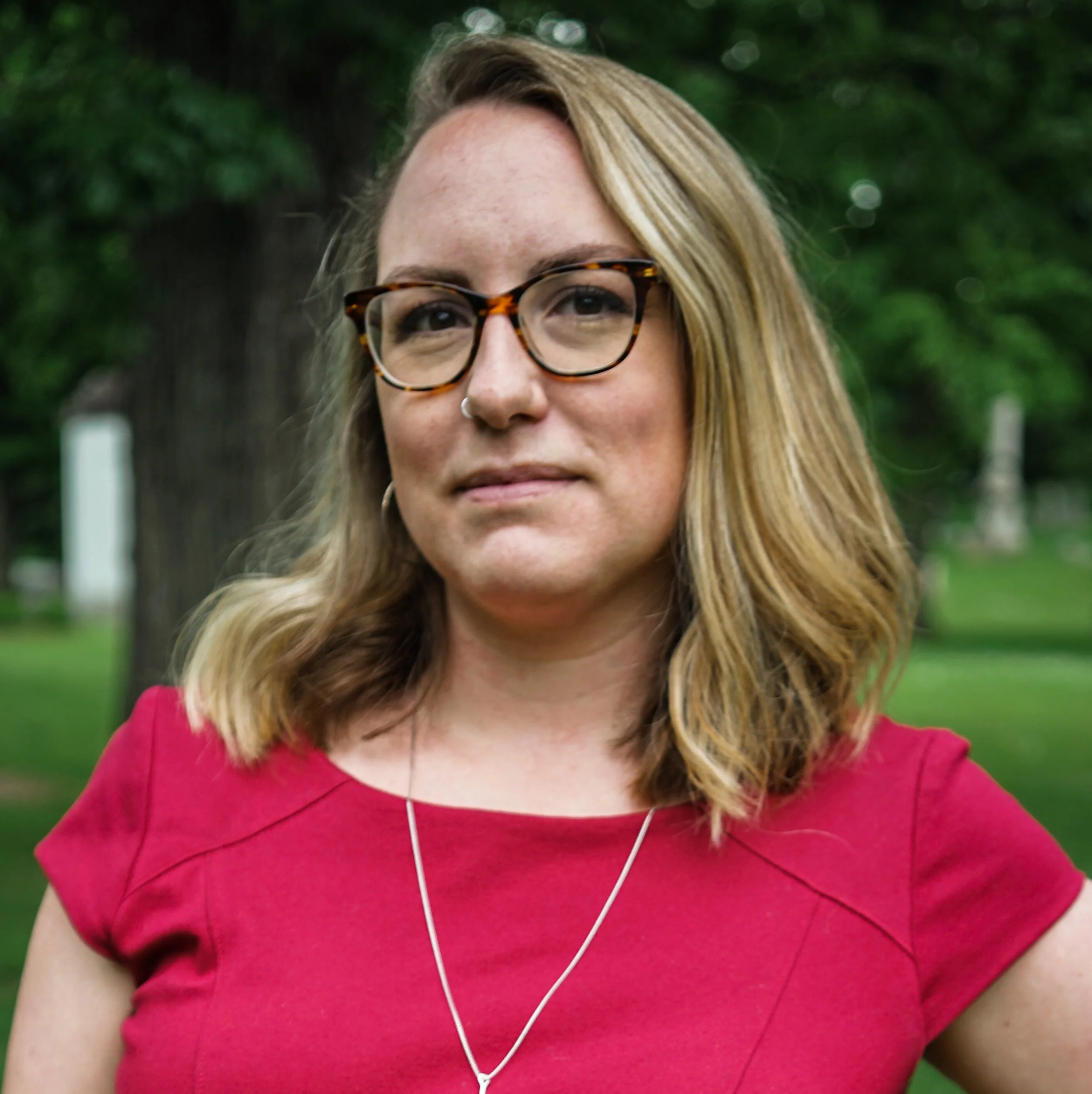
Sarah Handley-Cousins is an associate teaching professor of History at the University at Buffalo. Her first book, Bodies in Blue: Disability in the Civil War North, was published in 2019 by the University of Georgia Press. She is the executive editor of the digital publication Nursing Clio. She is the president of the Disability History Association and, until June 2026, served as Secretary of the American Association for the History of Medicine
The Corner Society "From Baby Blues to Postpartum Depression: A History of Maternal Mental Health
Rachel Louise Moran
Texas A&M University
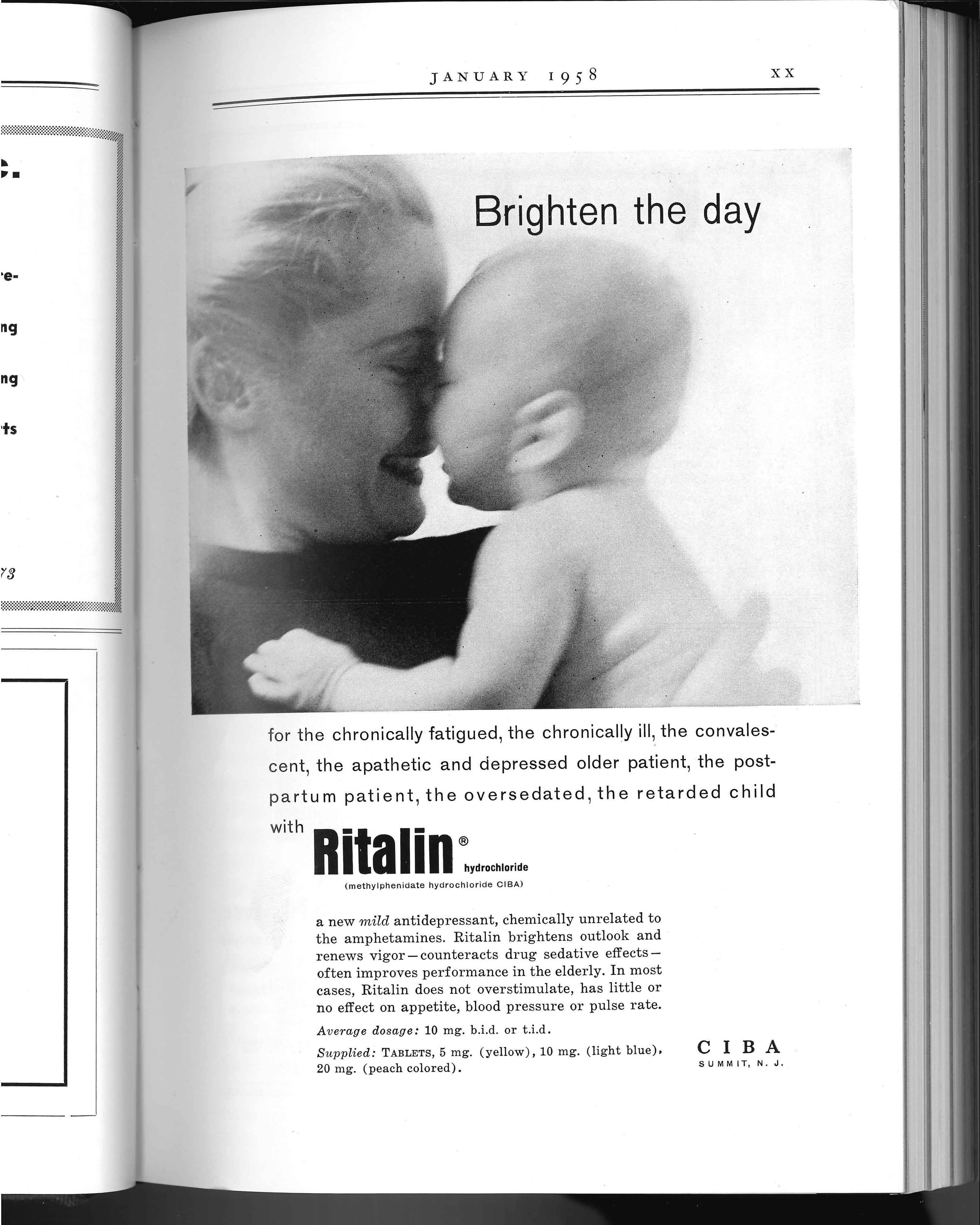
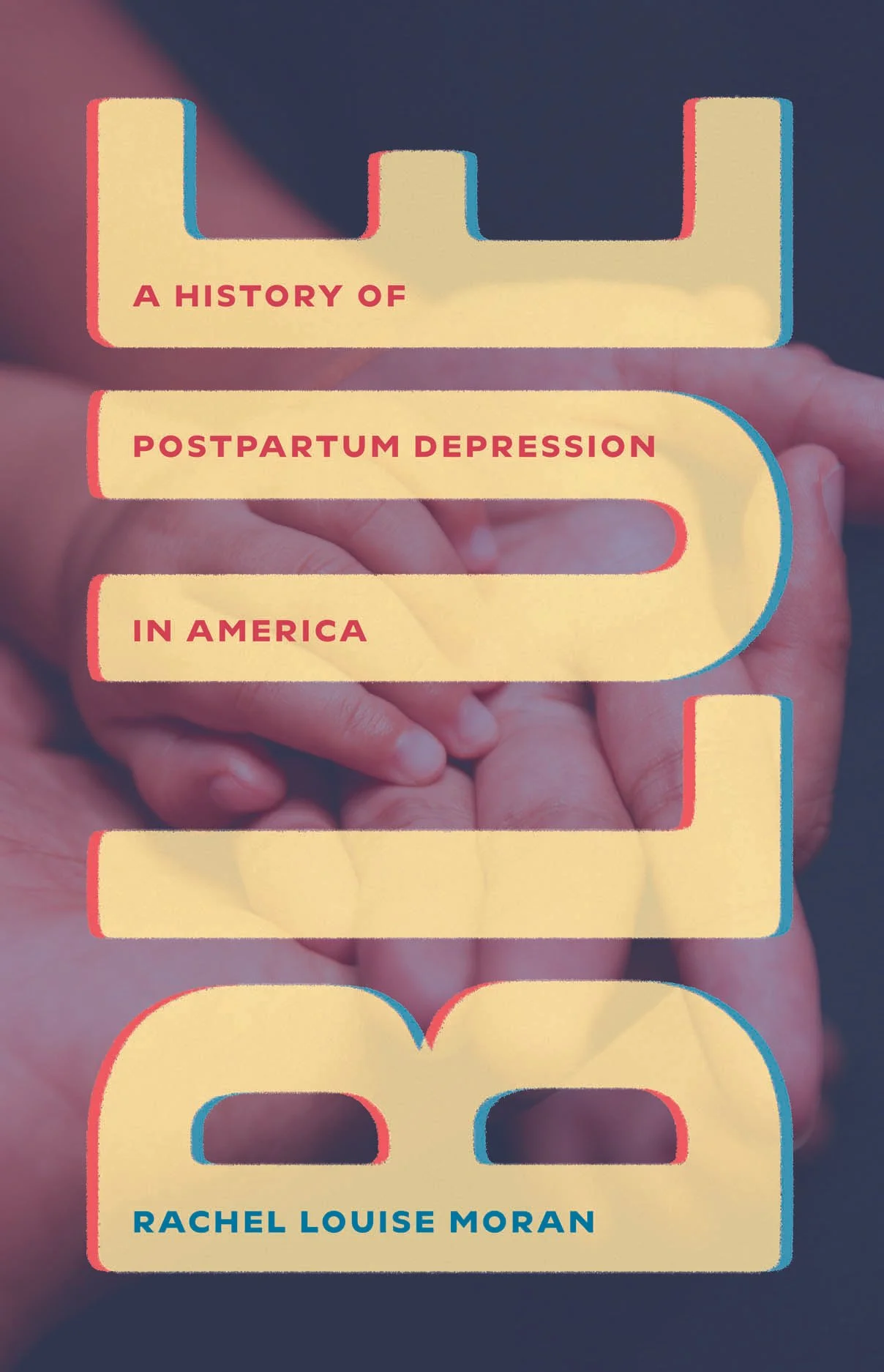
Postpartum depression is usually understood today as a medical condition rooted in hormones or brain chemistry. But how did it come to be defined this way? Drawing on my book, Blue: A History of Postpartum Depression in America, I trace the emergence of postpartum depression as a diagnostic and cultural concept from the mid-twentieth century to the present. I argue that our contemporary understanding of postpartum depression is the product of decades of negotiation among feminist activists, psychiatric researchers, and advocates working within everchanging political landscapes. Through a deep dive into the pivotal decades of the 1970s and 1980s, I discuss how postpartum distress was reframed first from the “baby blues” to a feminist critique of motherhood, and then later to a medicalized and increasingly apolitical diagnosis. This history helps explain why postpartum depression today is widely recognized but unevenly treated and why the condition has managed to remain apart from some of the intense political conflict that surrounds other aspects of women’s health.
Postpartum depression is usually understood today as a medical condition rooted in hormones or brain chemistry. But how did it come to be defined this way? Drawing on my book, Blue: A History of Postpartum Depression in America, I trace the emergence of postpartum depression as a diagnostic and cultural concept from the mid-twentieth century to the present. I argue that our contemporary understanding of postpartum depression is the product of decades of negotiation among feminist activists, psychiatric researchers, and advocates working within everchanging political landscapes. Through a deep dive into the pivotal decades of the 1970s and 1980s, I discuss how postpartum distress was reframed first from the “baby blues” to a feminist critique of motherhood, and then later to a medicalized and increasingly apolitical diagnosis. This history helps explain why postpartum depression today is widely recognized but unevenly treated and why the condition has managed to remain apart from some of the intense political conflict that surrounds other aspects of women’s health.
Rachel Louise Moran is a Professor of History at Texas A&M University, where she teaches courses on modern US history, women’s history, and the history of medicine. Her research focuses on how political cultures and institutions have shaped Americans’ relationships with health and wellness in areas including nutrition and fitness, psychiatry, and reproductive and sexual health. She is the author of Governing Bodies: American Politics and the Shaping of the Modern Physique (University of Pennsylvania Press, 2018) and Blue: A History of Postpartum Depression in America (University of Chicago Press, 2024). As part of writing Blue she also conducted oral histories that are now archived as the Maternal Mental Health collection with the University of North Texas’ Oral History Program. Her current book project explores the development of the Kegel pelvic floor exercise and the overlaps between women’s health, sexual dysfunction, and wellness culture since the 1940s. Dr. Moran has published research articles in the Journal of American History, Gender & History, Social History of Medicine, Journal of the History of the Behavioral Sciences, and the Journal of the History of Sexuality. Her projects have been supported by the National Science Foundation, the American College of Obstetricians and Gynecologists, and the Woodrow Wilson Foundation, among others.

Cool Wines from Cool Climates: Chillable Reds and Whites

Spend a warm summer evening tasting a curated selection of cool-climate wines with expert wine educator, Bruce Smoller.
August, 19, 2026
6:00 PM - 7:00 PM
Rochester Academy of Medicine
1441 East Avenue
Tickets
RAoM Member $20
General Public $25
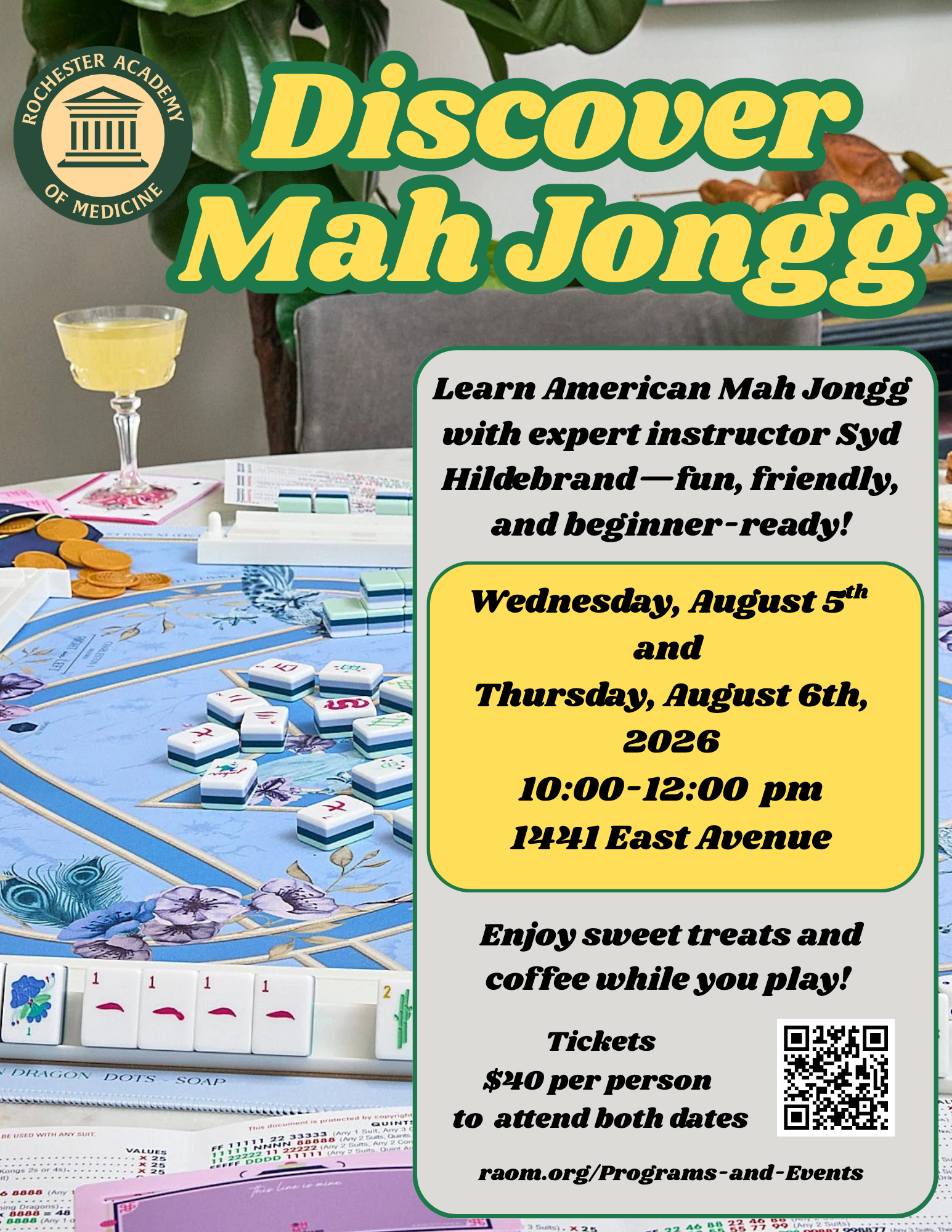
Discover MahJongg
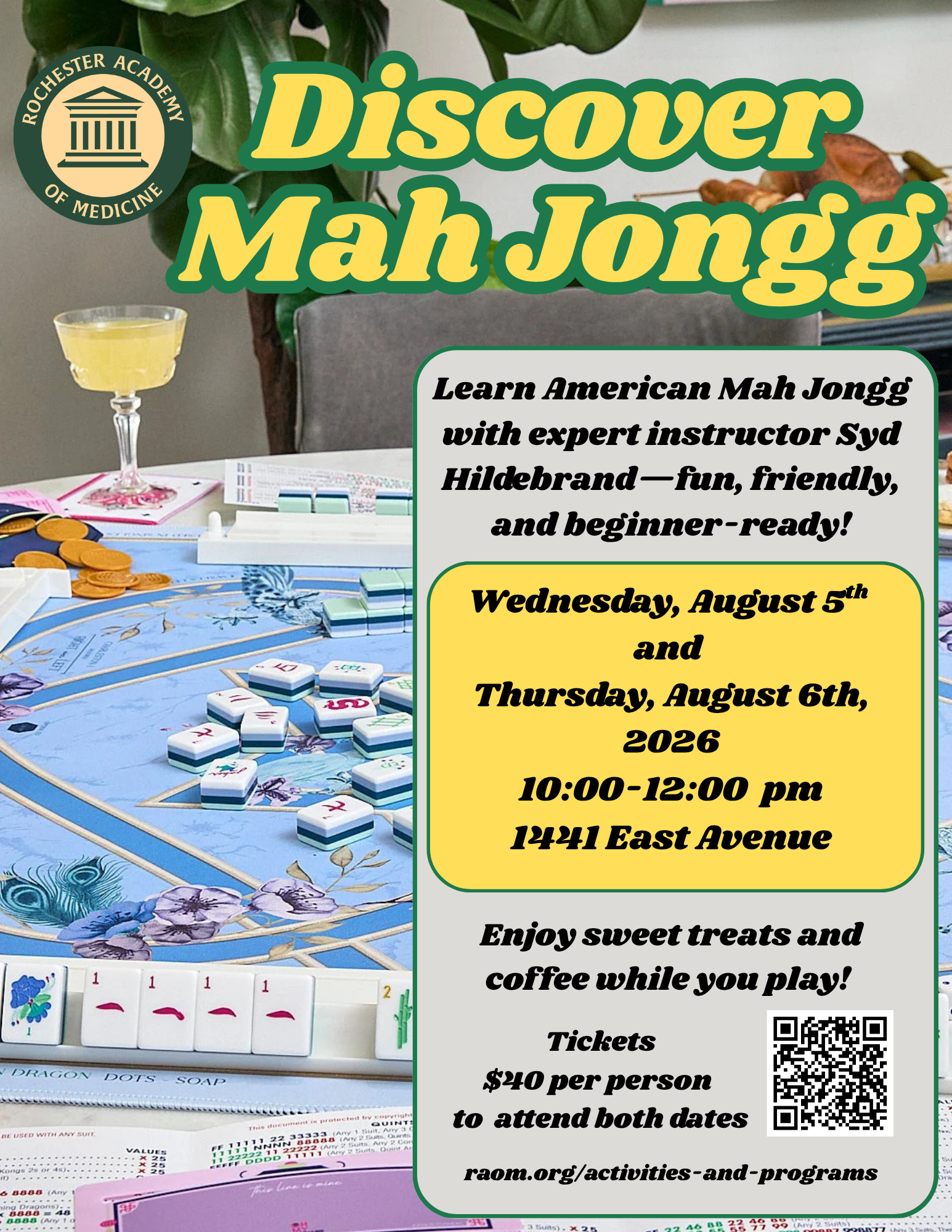
Wednesday, August 5th AND Thursday, August 6th
10:00 AM - 12:00 PM
Rochester Academy of Medicine
1441 East Avenue
Registration
$40 individual ticket (payment to attend both dates)
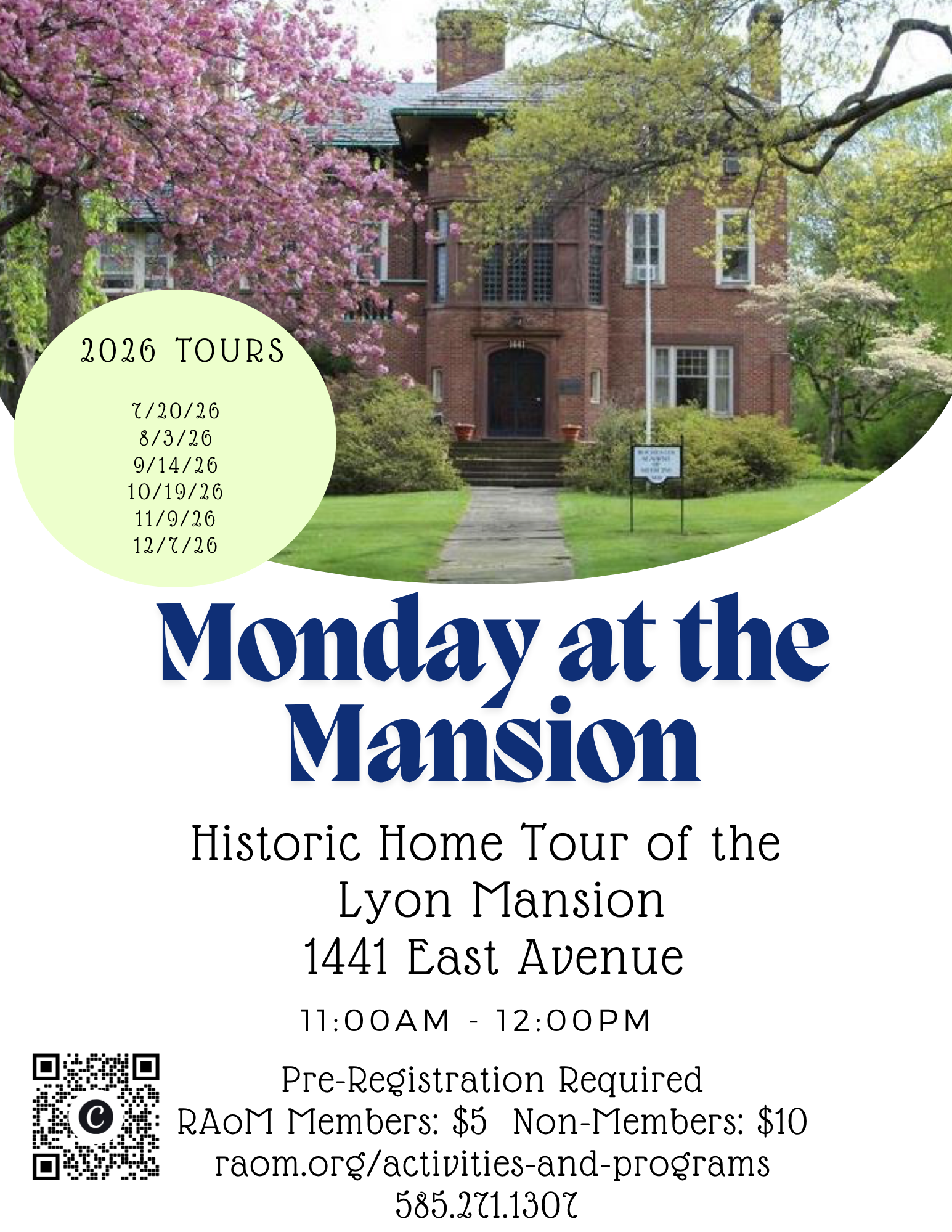
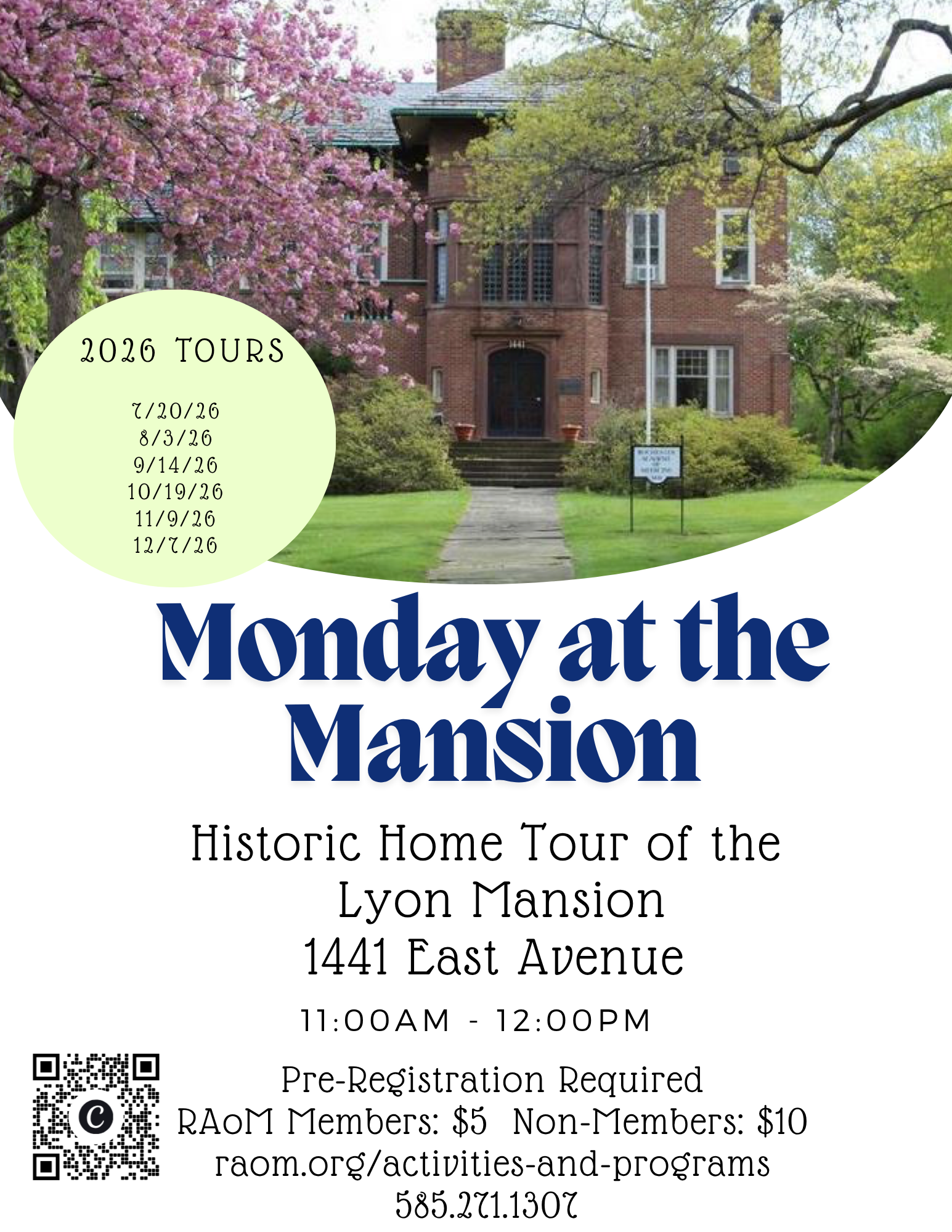
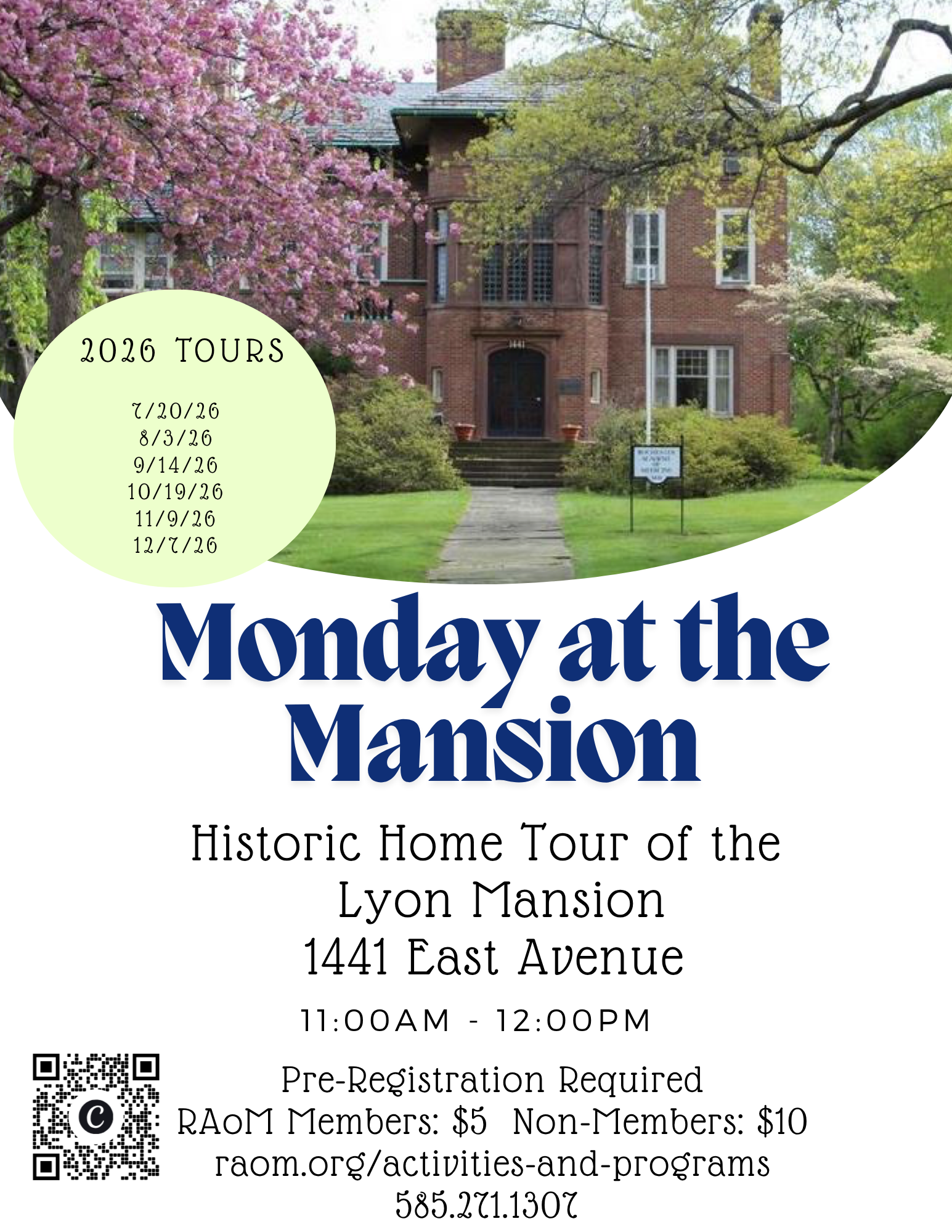
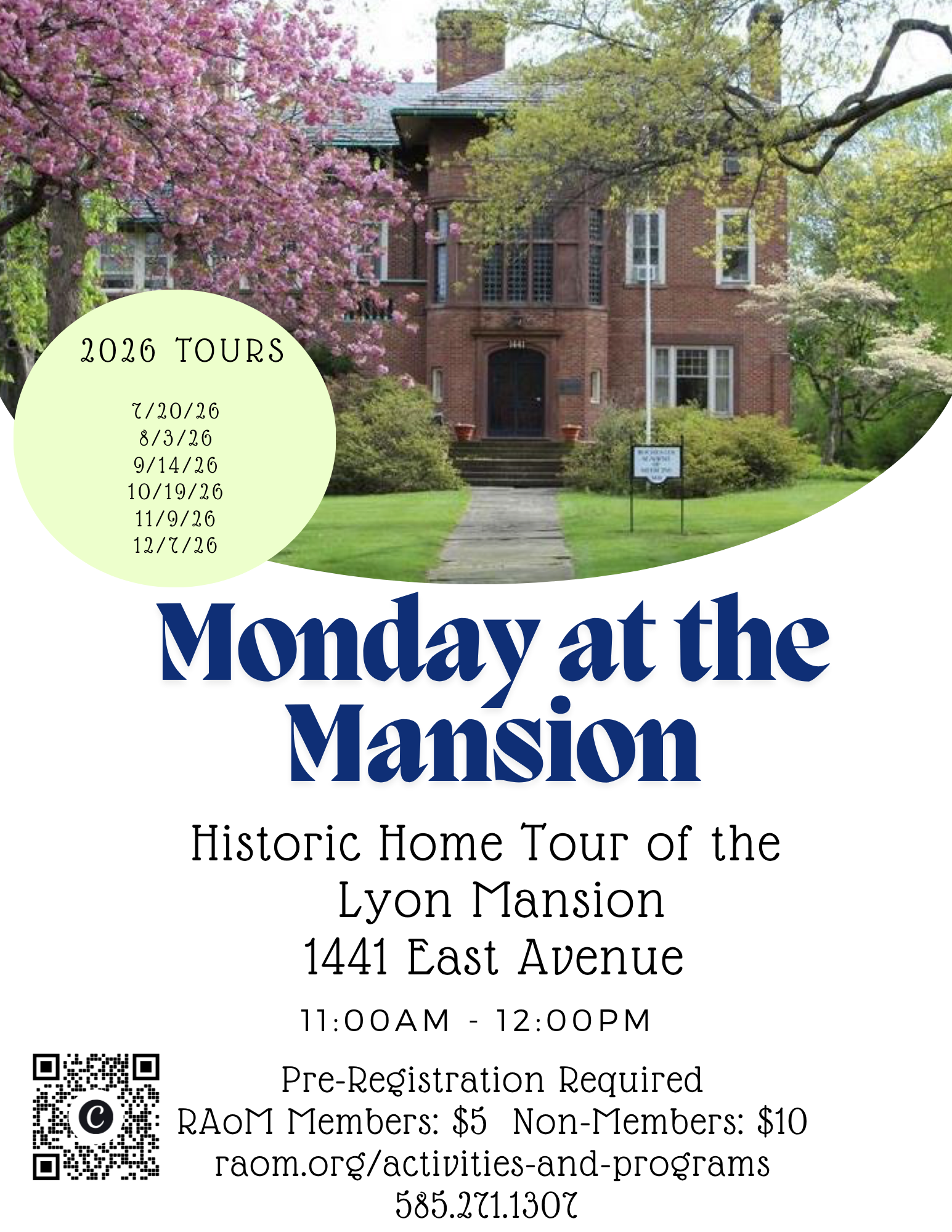
8/3/2026 Monday at the Mansion
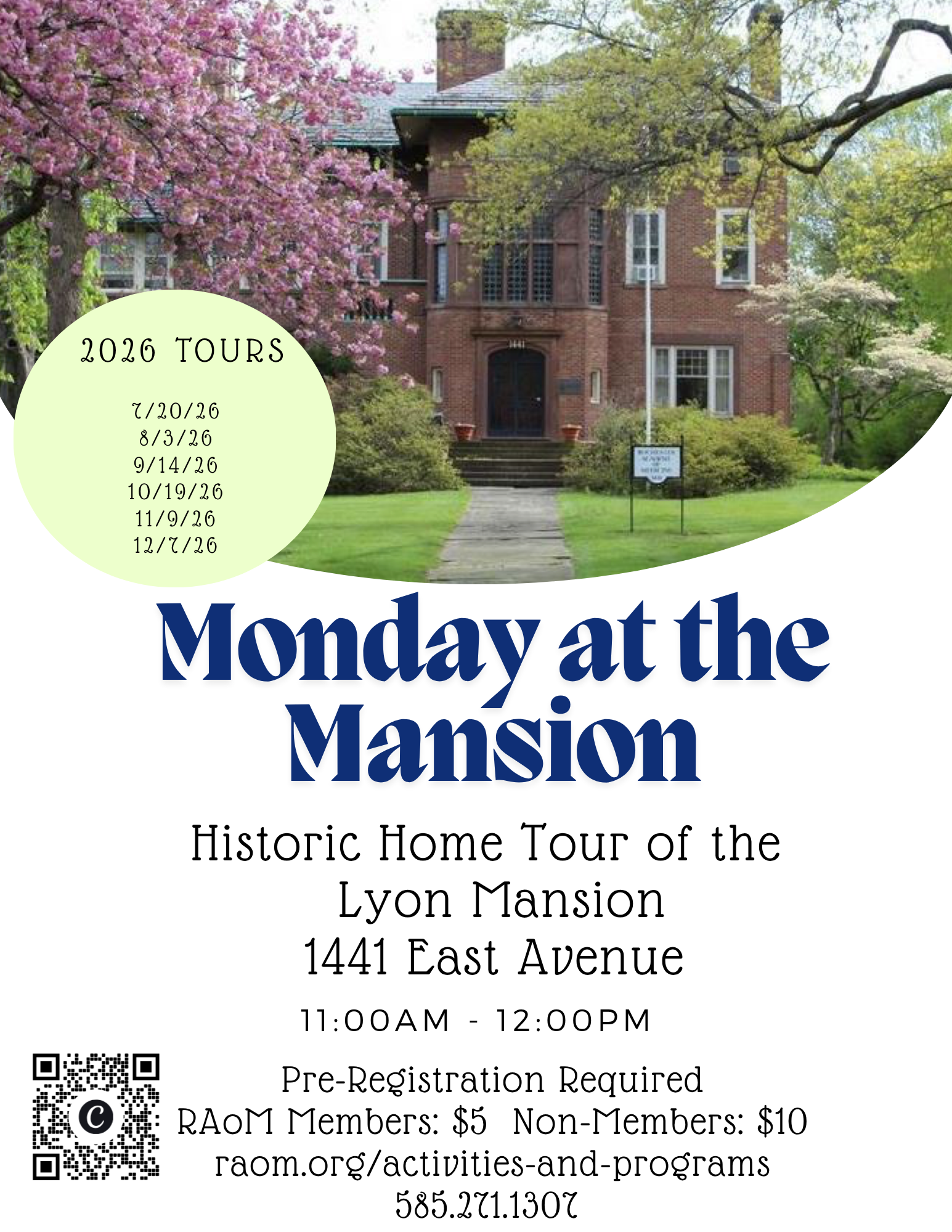
Monday, August 3, 2026
11:00 AM - 12:00 PM
Rochester Academy of Medicine
1441 East Avenue
Registration
RAoM Members $5
Non-Members $10
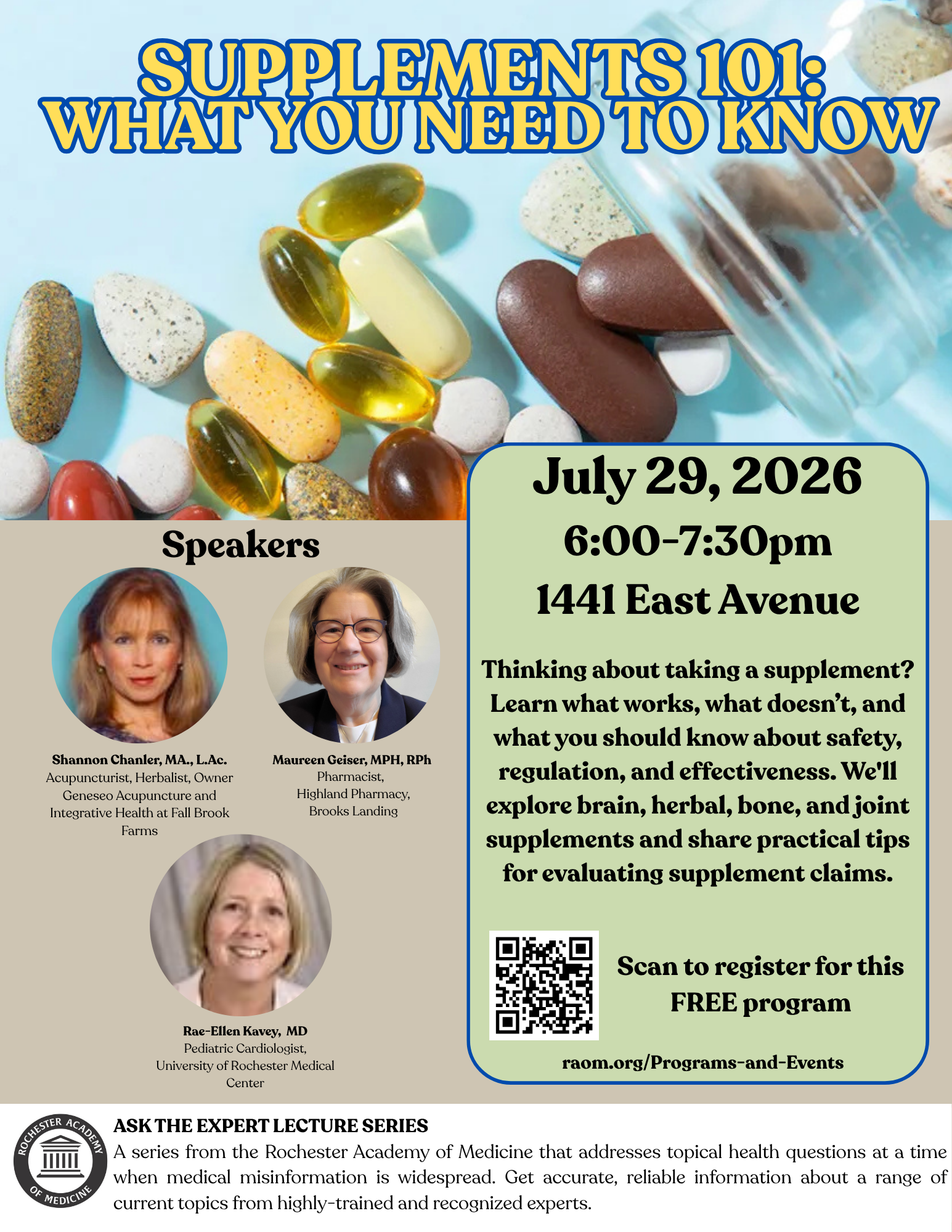
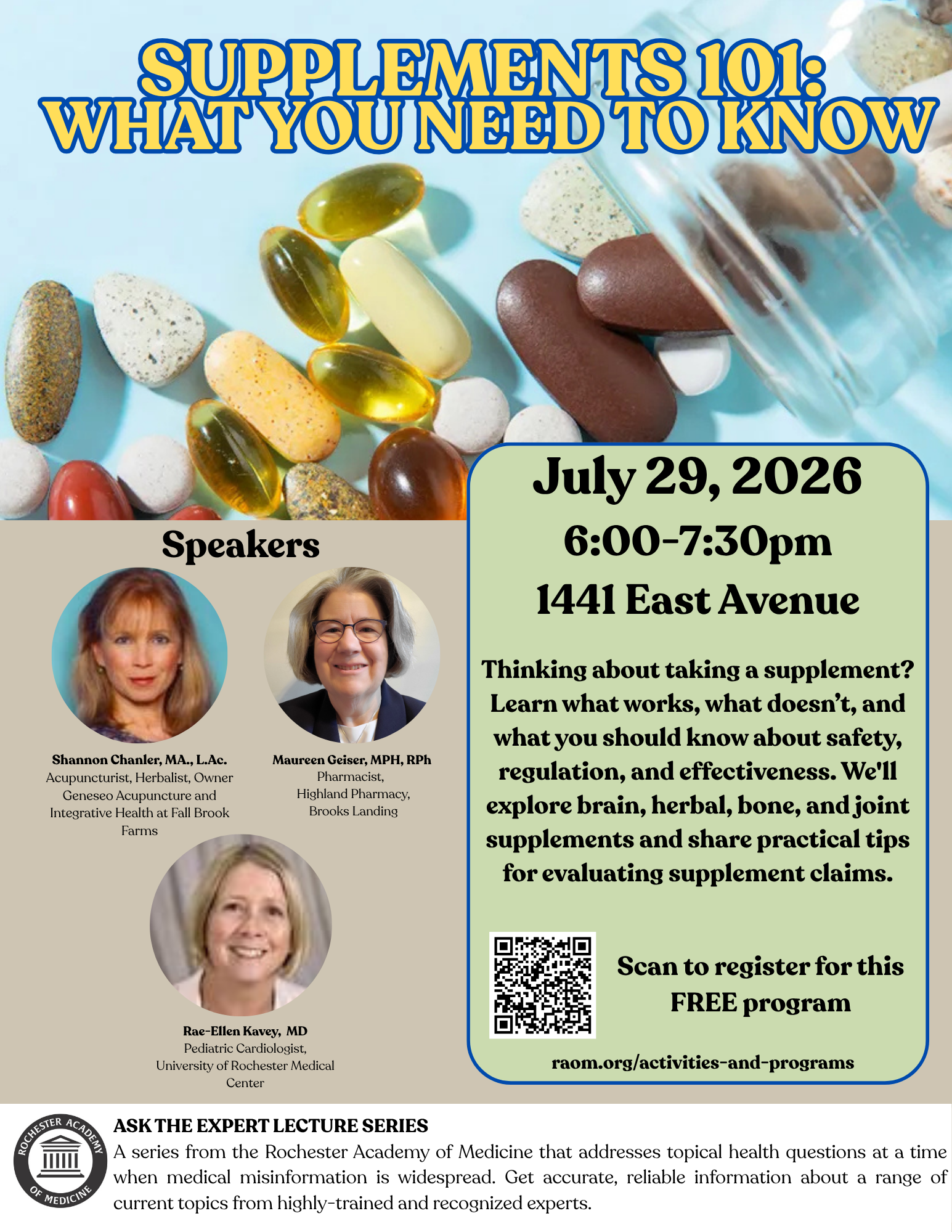
Supplements 101: What You Need to Know
Rochester Academy of Medicine
1441 East Avenue
Free Admission
Registration
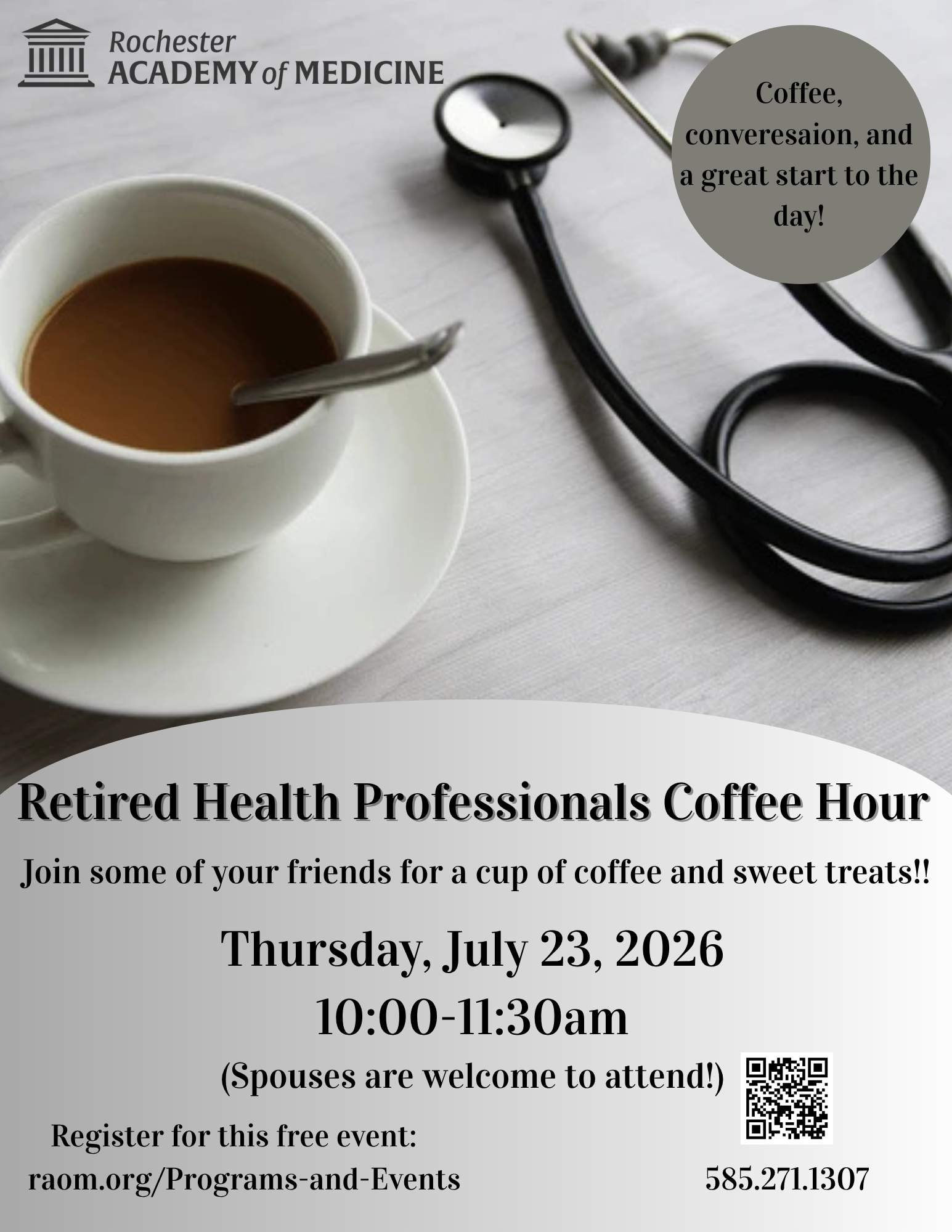
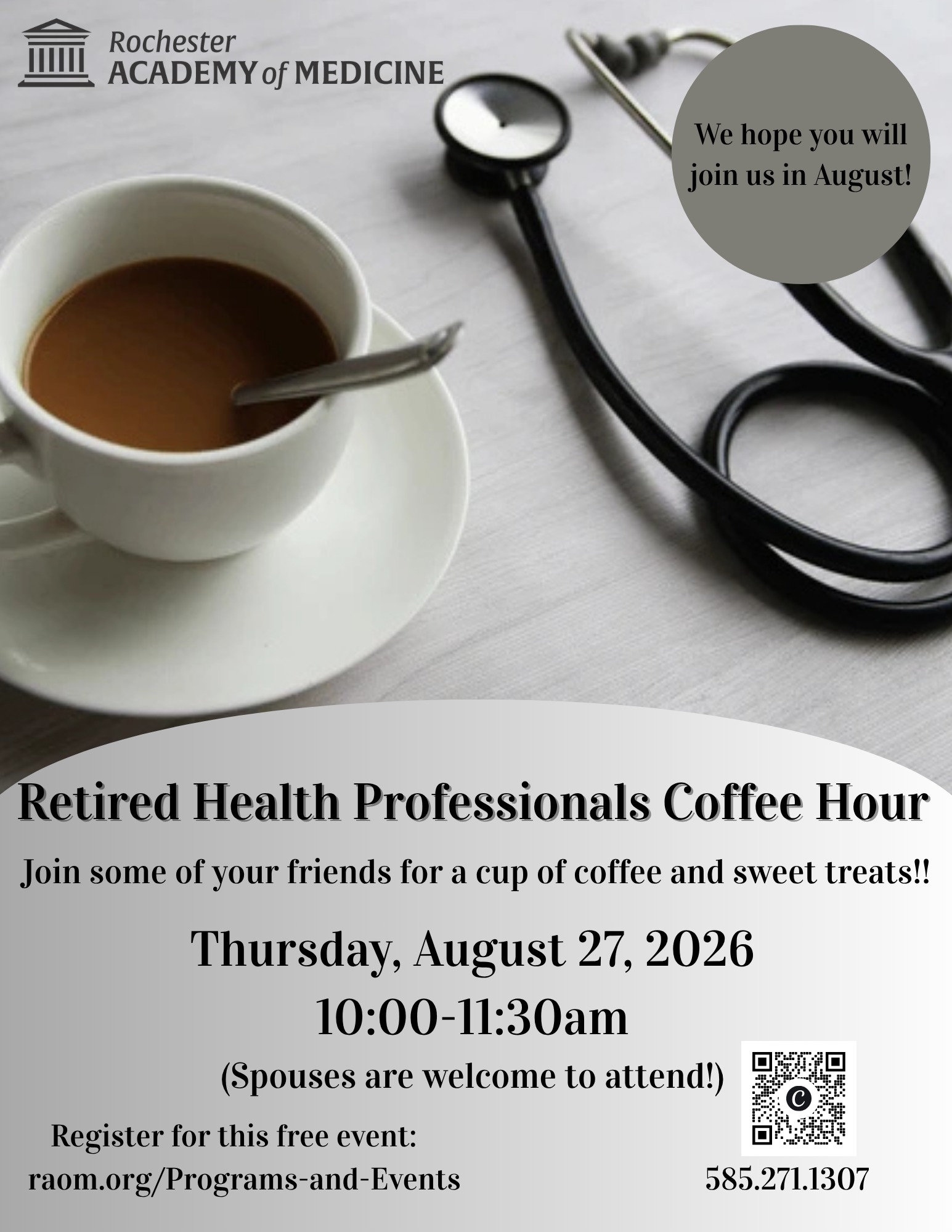
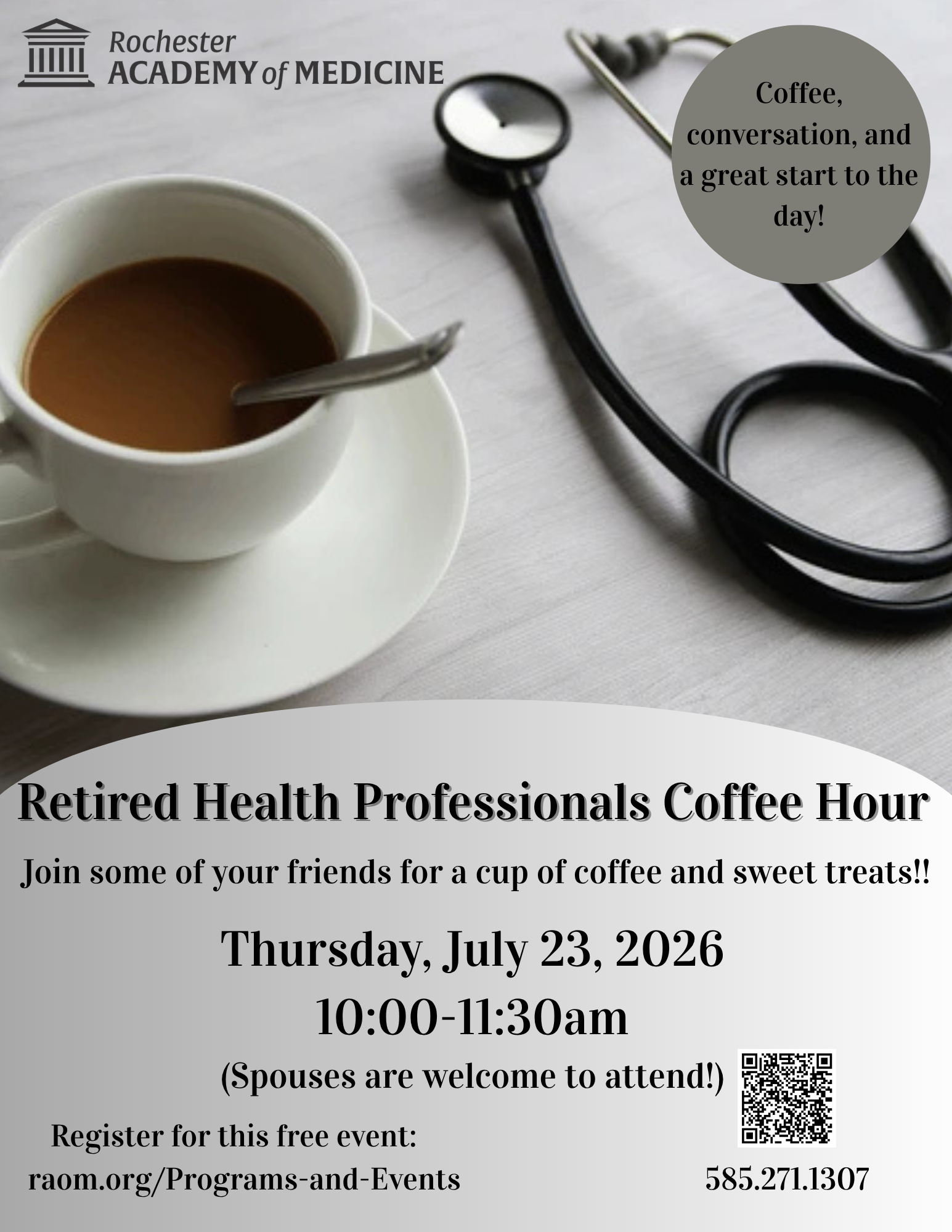
Retired Health Professionals Coffee Hour
Rochester Academy of Medicine
1441 East Avenue
Free Event
Registration
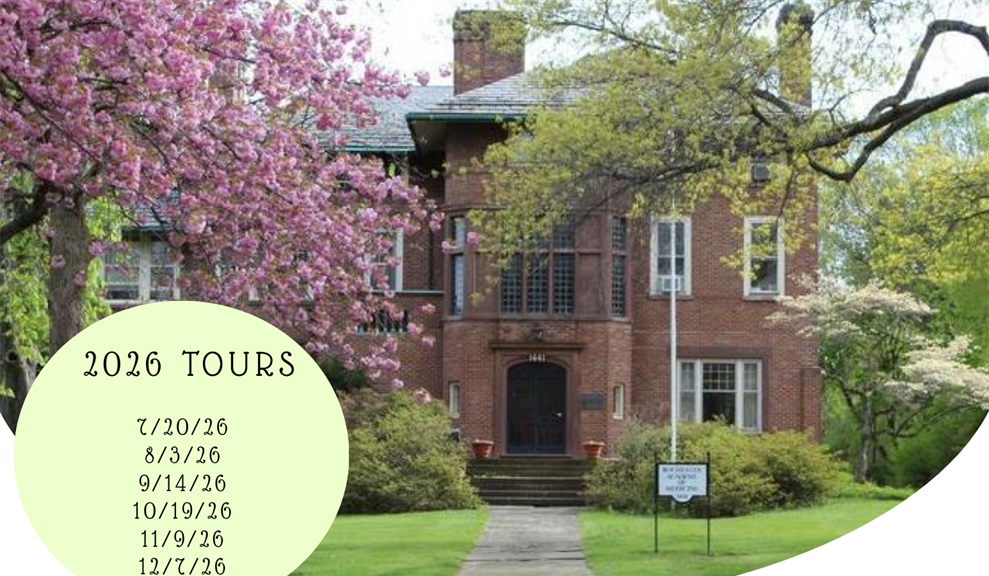
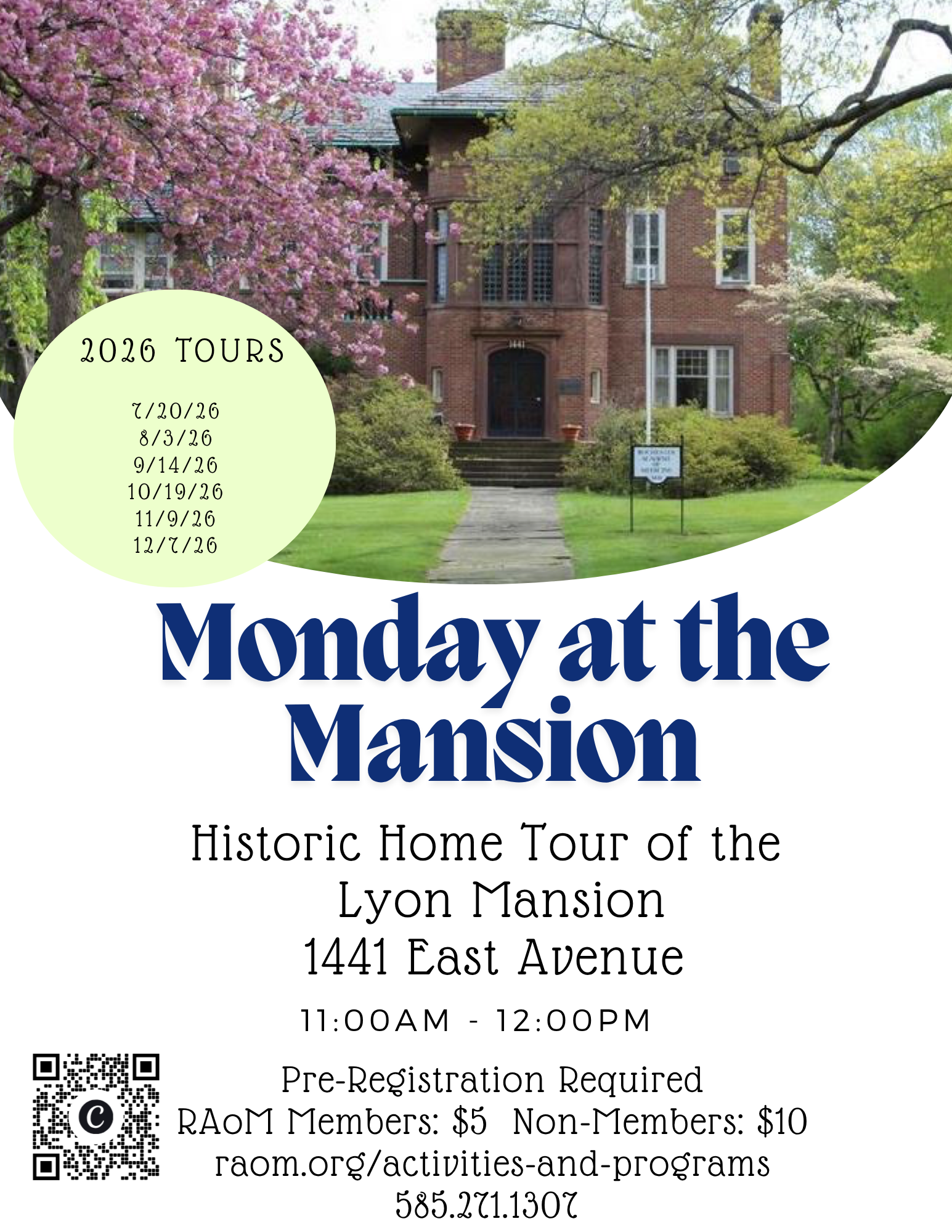
Monday at the Mansion 7/20/26
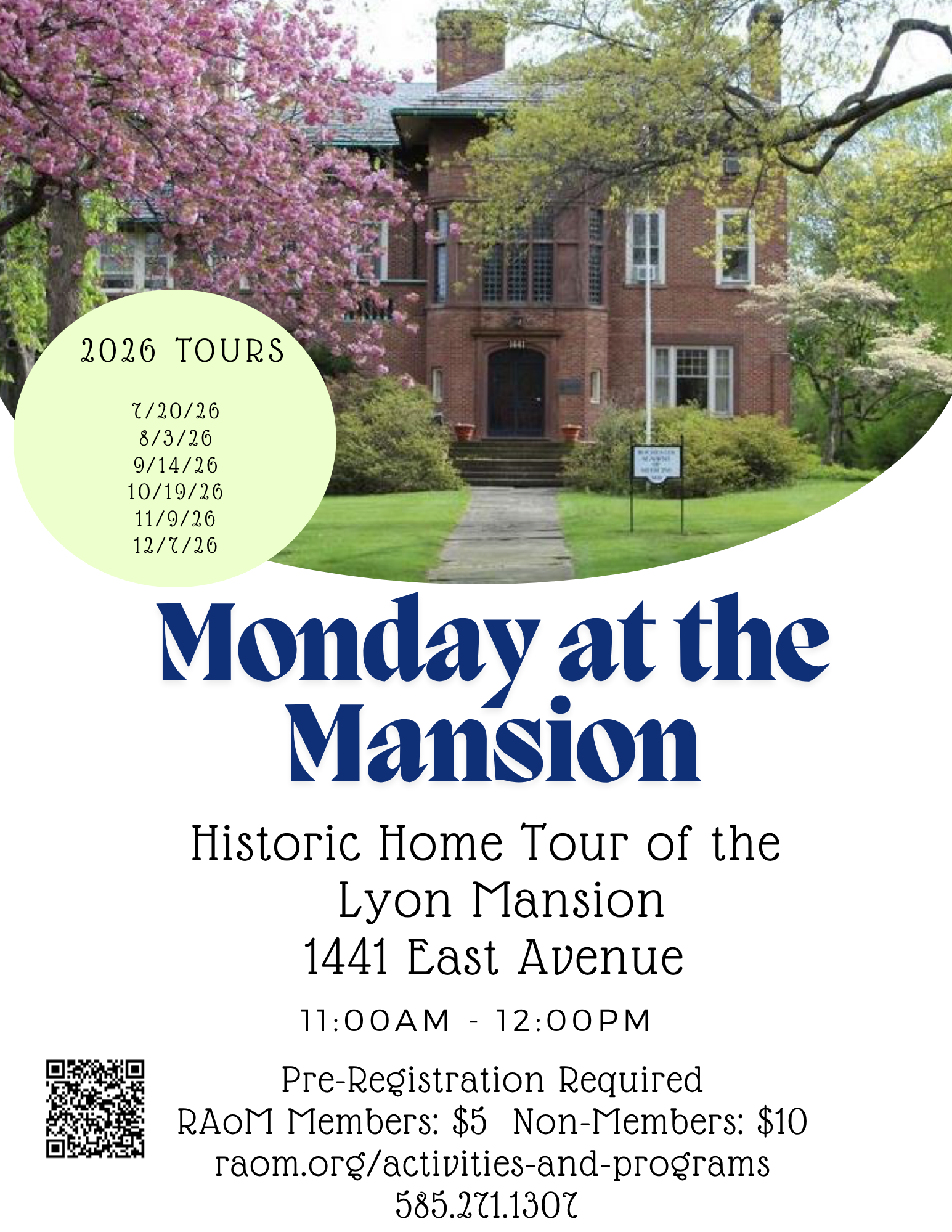
Monday, July 20, 2026
11:00 AM - 12:00 PM
Registration
Individual Ticket – $10.00
Member of RAoM – $5.00

Grilling and Grillo: Wines to Pair with Your Summer Barbeques

Wednesday, July 15, 2026
6:00 PM - 7:00 PM
Registration
Individual Ticket – $25.00
Member of RAoM – $20.00
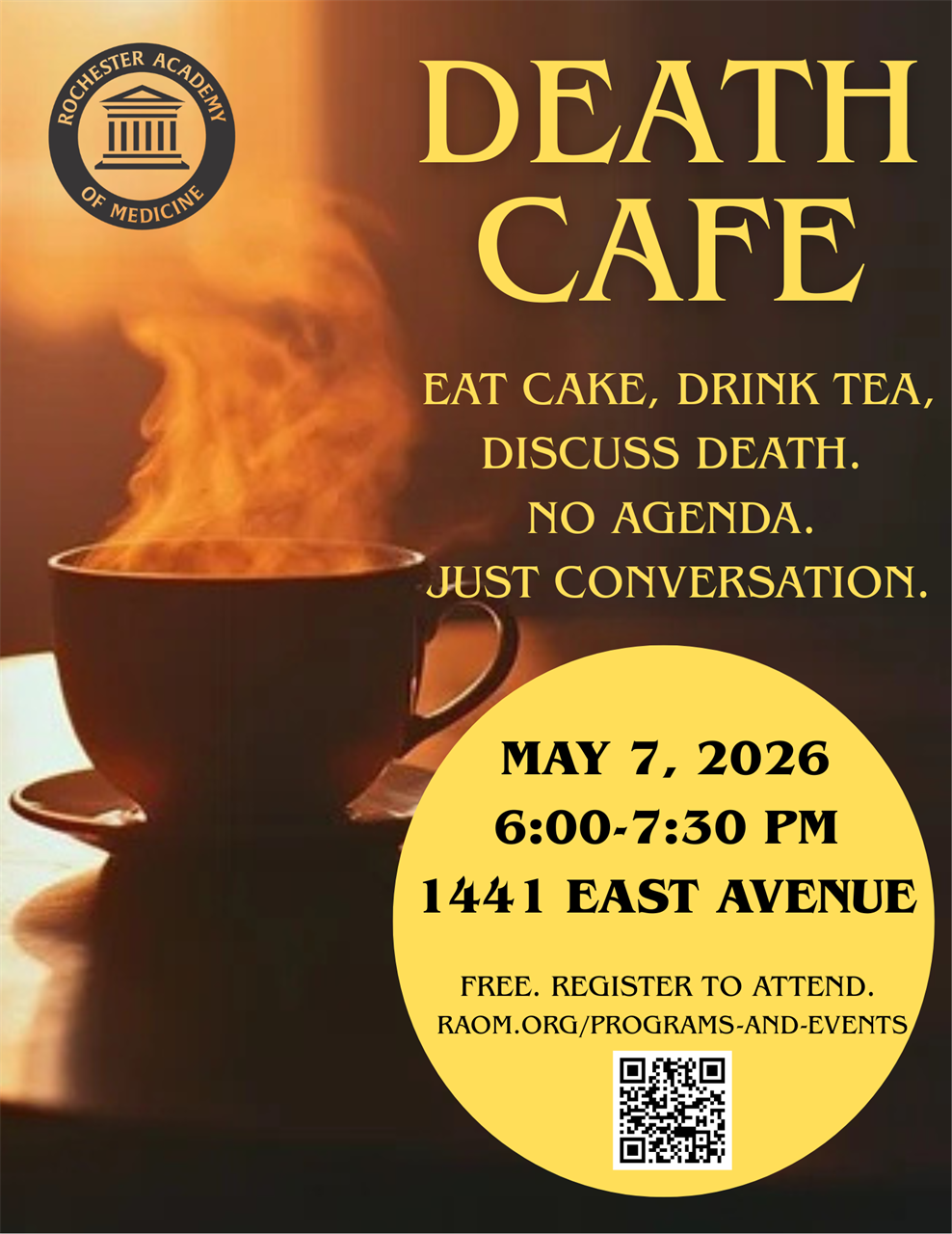
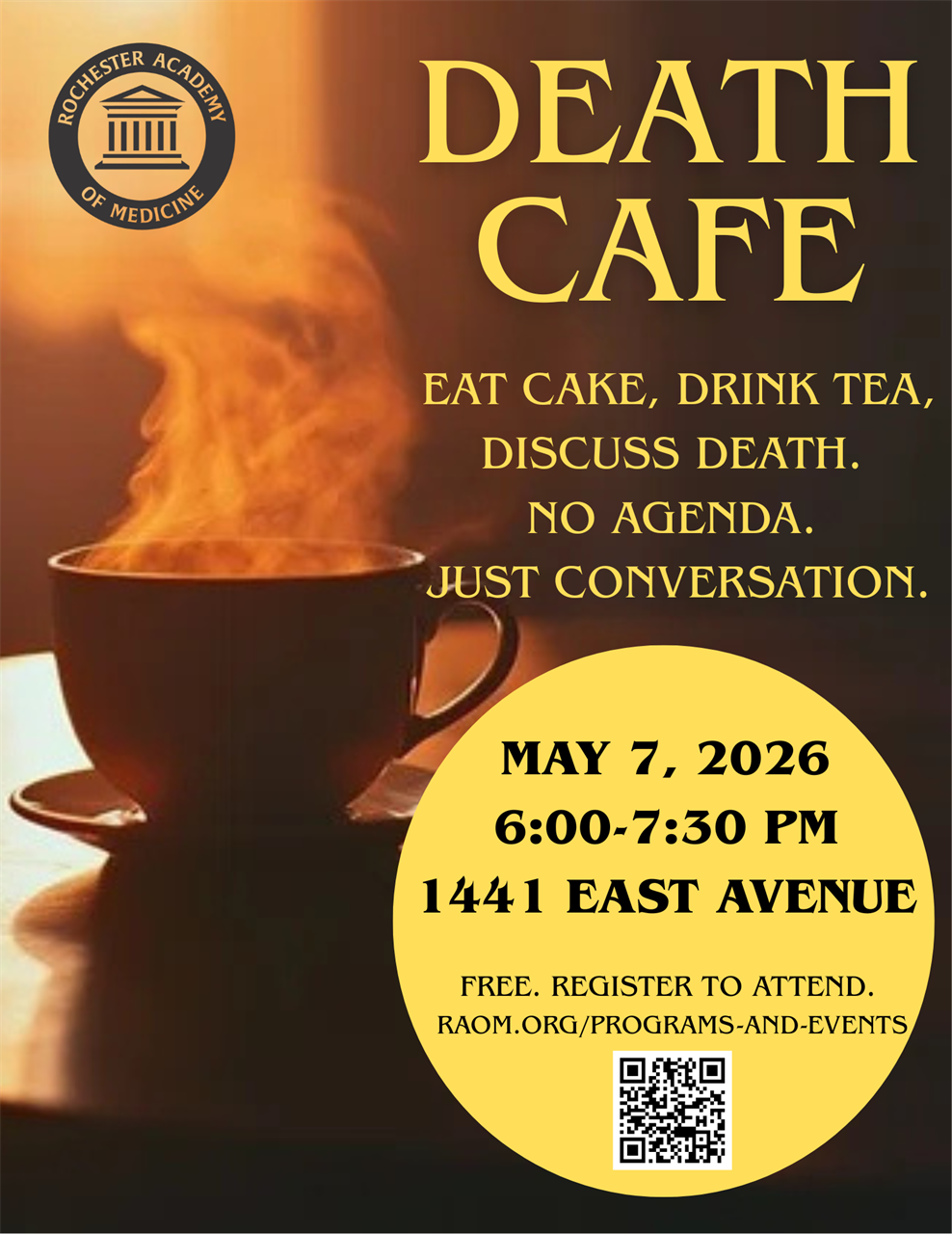
Death Cafe
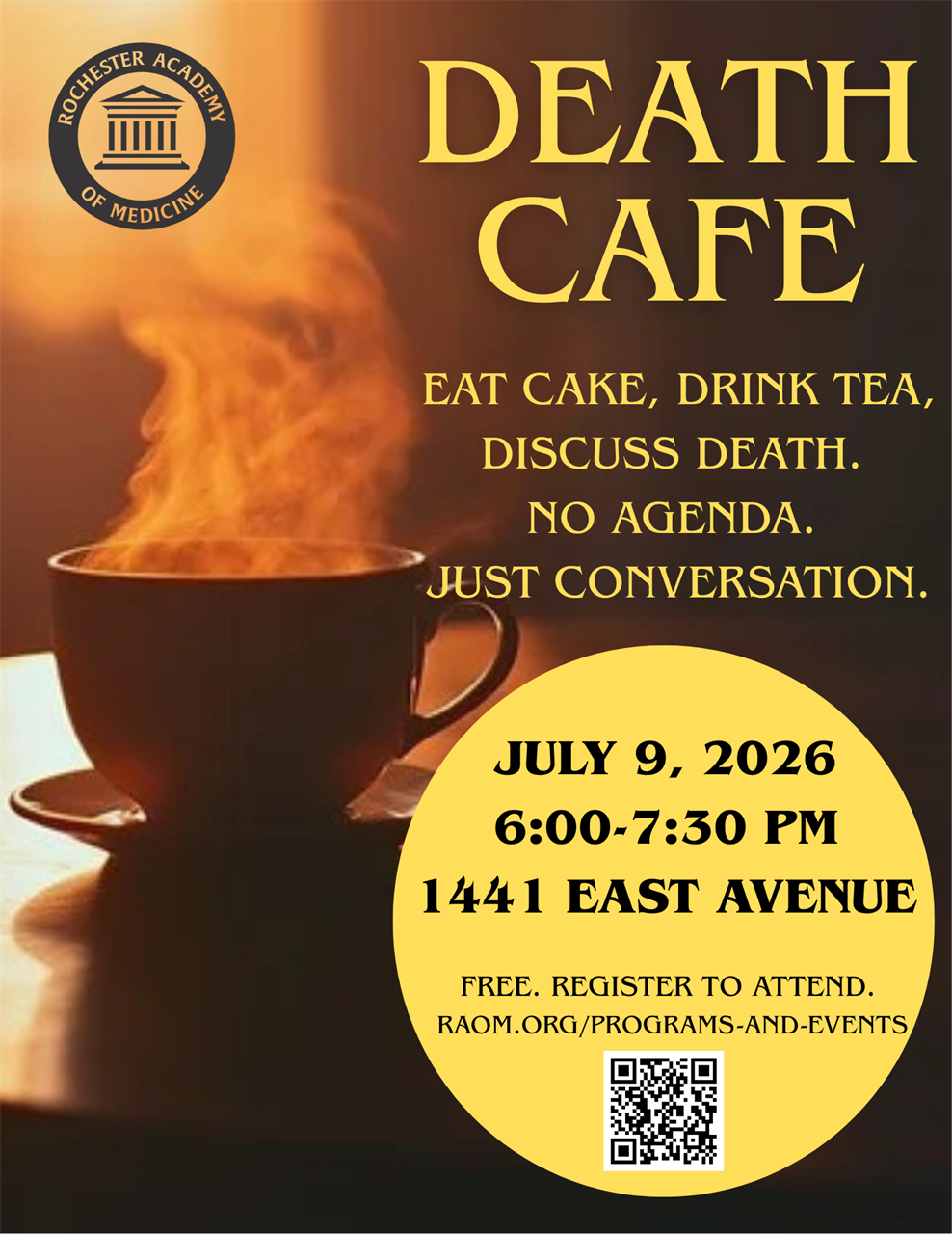
Death Cafe
Thursday, July 09, 2026 6:00 PM - 7:30 PM
Location: 1441 East Avenue
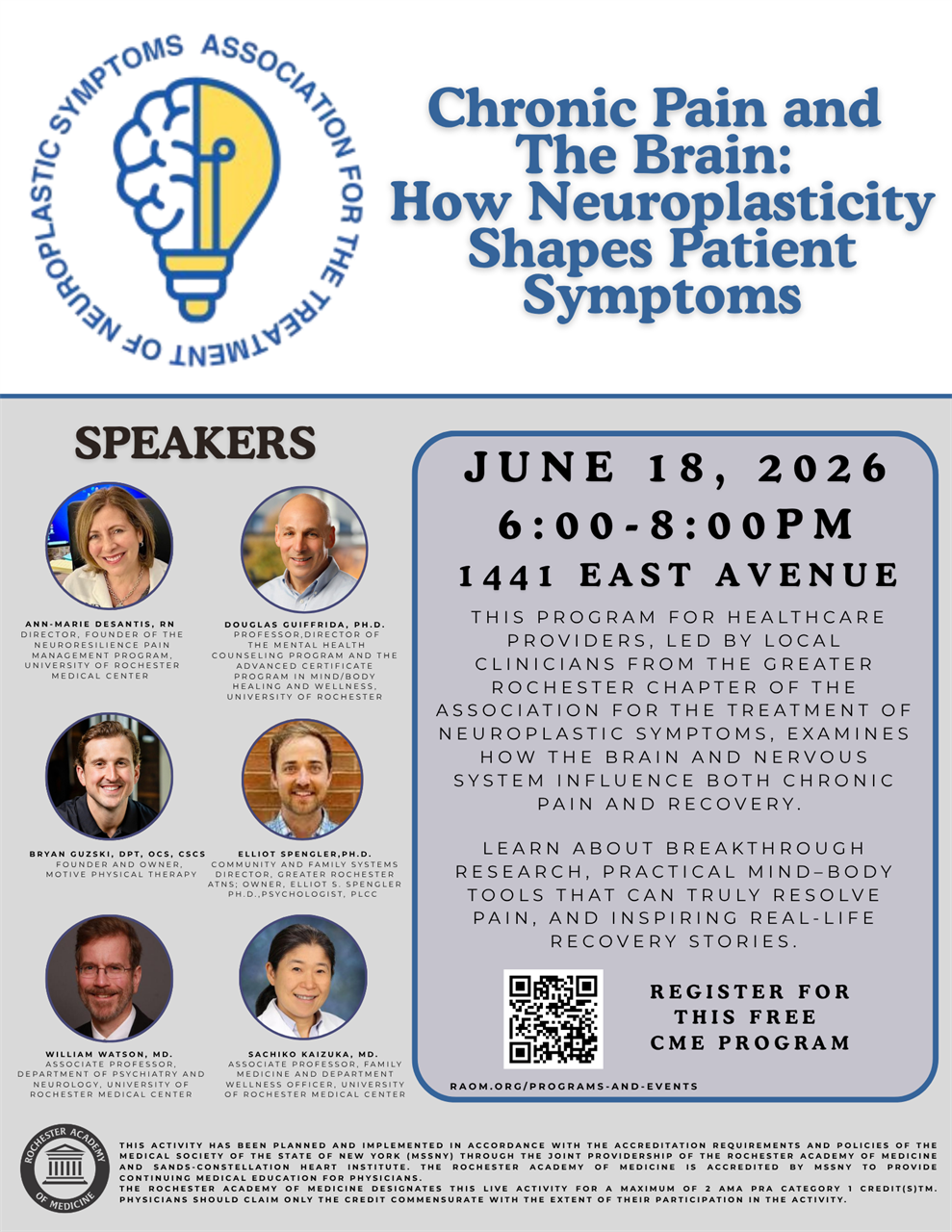
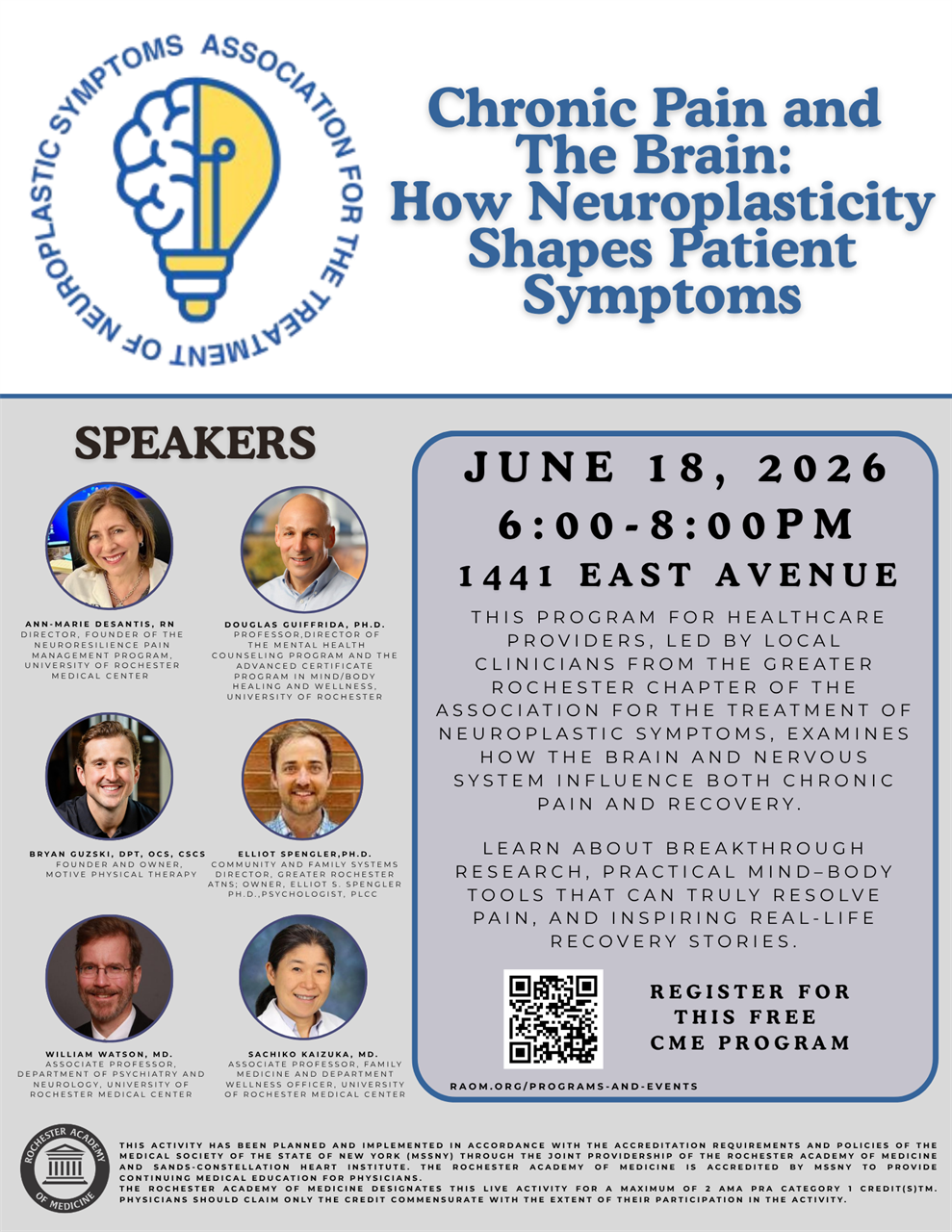
Chronic Pain and the Brain: How Neuroplasticity Shapes Patient Symptoms
To register for this event please fill out the information below.

250th Anniversary Celebration: Sharing the Wine Palate of Thomas Jefferson
Register by filling out the form below


AI in Medicine: Applications, Benefits, and Risks for Providers
Register by filling out the form below
